


I gave three different clients the same piece of advice this week, almost word for word. When that happens, it usually means we’re on to something.
The advice? Stop posting so many shorts.
With one, I asked them to unlist the shorts already on the channel and pause new ones entirely while we build out the long-form strategy. Another had brand deals lined up specifically for short-form and wanted to keep feeding it. A third was posting a short a day, because that’s what everybody says to do.
All three were doing the thing that feels like free reach, but is a slow-acting tax on the channel they actually want to build.
Here’s the epiphany:
YouTube decides what kind of channel you are, and then serves your videos to that channel’s audience.
It decides based on what you upload. Post mostly shorts, and you’re a shorts channel now. Congratulations.
Then you drop a 14-minute video, and YouTube does exactly what you’d expect: it serves it to the audience it thinks you have. Which is a shorts audience. People in a feed, thumb hovering, in a completely different mode. They are not sitting down for your deep dive. They swipe.
YouTube reads that swipe as “this video didn’t work” and pulls back distribution. It’s not personal. It’s a simple audience mismatch.
And it runs the same way in the other direction. Serve short-form to a long-form audience and it doesn’t land either. Someone who subscribed for your 20-minute breakdowns isn’t scrolling for a 30-second clip of you. They came for the sit-down version.
Two audiences that behave nothing alike. Give either one the wrong format and you get penalized twice. Once when they don’t watch, and again when the algorithm quietly updates its idea of who you are.
So this isn’t an anti-shorts position. It’s an audience problem.
If your priority is long-form, you should treat shorts as a supporting act. Two or three per week should do the trick as long as it’s tied to a long-form upload. One a day runs the risk of redefining your channel.
But there’s another key detail: make them for the shorts audience. A horizontal clip lifted out of your video, letterboxed into a vertical frame, is the worst of both worlds (unless you’re a podcast). It underperforms as a short and it muddies the signal on your main feed. I know this because we’ve tested it and seen consistent results across multiple channels.
I believe the clip channel is still a viable option. I bet you can easily name a half-dozen creators running a secondary shorts channel. But notice when they started - after they were already enormous with enough demand that a second channel quickly took off. Before that, a clip channel is just you funneling your efforts away from your primary goal.
A word on sponsor pressure, because short-form deal flow has ramped up noticeably this summer. I’m not going to tell you to leave money on the table. Take the deals. Just understand the risks and don’t let the deliverables quietly reshape your upload pattern into something you never chose.
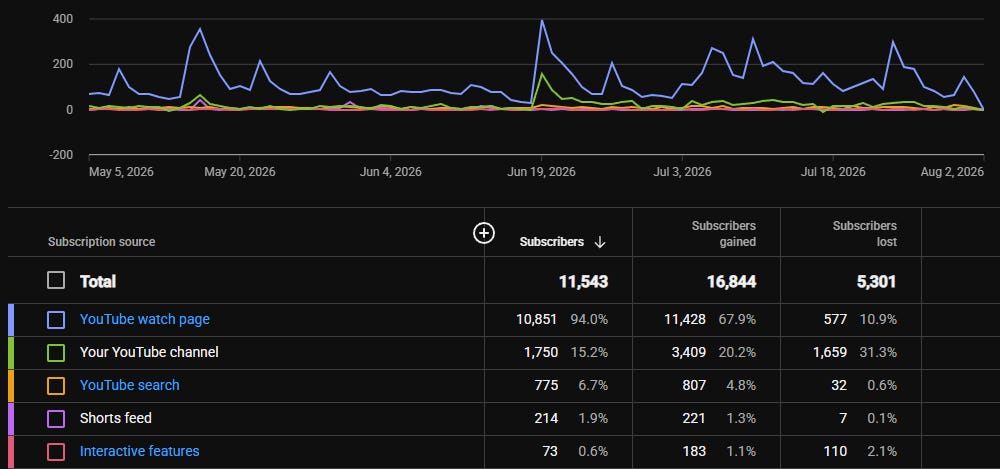
If you want to know where you actually stand, this takes about two minutes. Open YouTube Studio, set it to the last 90 days, and look at where your new subscribers came from: shorts or long-form.
If most of them came from shorts, there’s your answer. That’s the audience YouTube is handing your next 15-minute video to, and that’s why it’s landing softer than it should.
Then look at the ratio. How many shorts went up against how many long-form videos? If you can’t say out loud what that ratio was supposed to accomplish, the algorithm can’t either.
None of this makes shorts the enemy. It just means you have to pick which audience you’re building, and then upload like you mean it.
Can I also just add that this is kinda depressing? This entire exercise makes me realize that we’re straying further away from what made YouTube beautiful to begin with: people uploading great content and easily reaching an audience organically - not having to worry about gaming an algorithm.
It’s really hard to keep up with what YouTube wants, and it’s even harder to change what you’re doing once you figure out what that is.
But that’s for another time.
Go get ’em.